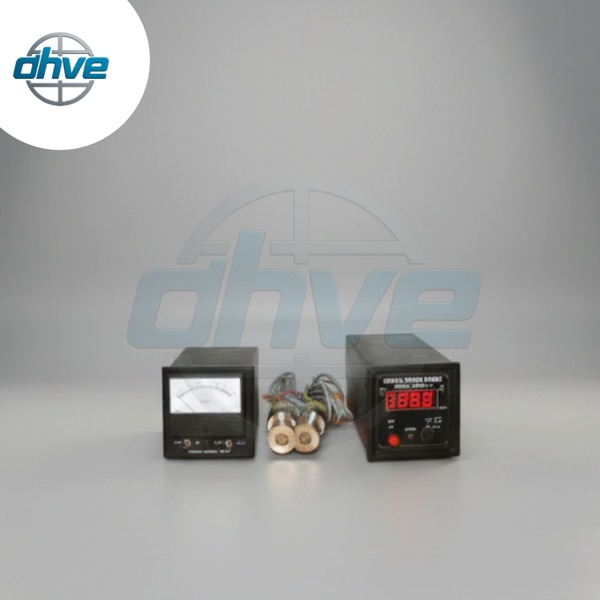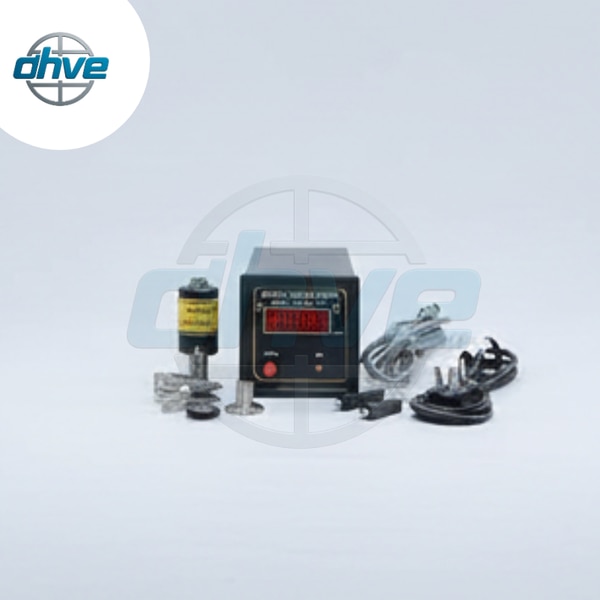
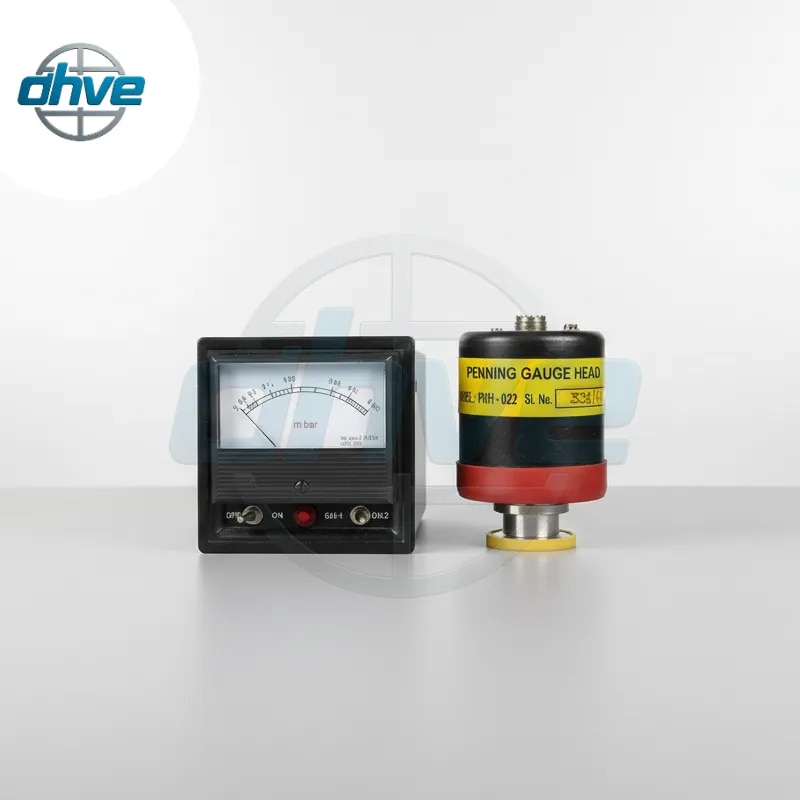
Analog Penning Gauge
Description
For rugged, reliable measurement in the high vacuum to ultra-high vacuum range (typically 10^{-2} to 10^{-9} mbar), the Analog Penning Gauge (also known as a Cold Cathode Gauge) is the industry's preferred workhorse. Unlike hot-cathode gauges that use delicate filaments, the Penning gauge is robust, resistant to sudden pressure bursts, and ideal for harsh industrial environments.
Dinesh High Vacuum Engineering (DHVE) supplies high-quality Analog Penning Gauges designed to provide operators with immediate, clear visual feedback on deep vacuum levels without the complexity or fragility of other high-vacuum sensors.
I. ⚙️ Principle of Operation: The Cold Cathode Discharge
The Penning Gauge measures pressure through gas ionization. However, unlike 'hot' gauges that boil electrons off a filament, the Penning gauge uses a high voltage and a magnetic field to create a self-sustaining discharge at low pressures.
How It Works
The Cell Structure: The gauge head contains two electrodes: an anode (usually a central ring or rod) and a cathode (plates or a cylinder connected to ground).
High Voltage: A high DC voltage (typically 2 to 3 kilovolts) is applied between the anode and cathode. This electric field accelerates any free electrons present in the chamber.
The Magnetic Trap: A strong permanent magnet surrounds the gauge tube. This magnetic field forces the electrons to travel in long, spiraling helical paths rather than going straight to the anode.
Ionization: Because the electrons travel such a long distance, their probability of colliding with gas molecules increases dramatically. These collisions knock electrons off gas molecules, creating positive ions.
Current Measurement: The positive ions are attracted to the cathode, creating an electrical current. This discharge current is directly proportional to the gas density (pressure). The analog meter measures this current and displays it as a pressure reading.
II. 📊 Why Choose an Analog Penning Gauge?
While digital sensors are common, the Analog Penning Gauge from DHVE offers specific advantages that keep it relevant and highly valued in heavy industry:
Extreme Robustness (No Filament): The 'Cold Cathode' design means there is no hot filament to burn out. This makes the gauge incredibly durable and immune to failure from vibration or accidental exposure to atmospheric pressure (air inrush), which would instantly destroy a hot-cathode gauge.
Instant Visual Trend Monitoring: The analog needle movement allows operators to see the rate of pump-down or pressure fluctuations at a glance, often faster and more intuitively than watching jumping digits on a screen.
Cost-Effective High Vacuum Sensing: Penning gauges are generally more affordable than Bayard-Alpert (hot cathode) gauges while covering a similar high-vacuum range.
Low Maintenance: The sensing head is simple and can often be disassembled and cleaned (sandblasted or polished) to remove contaminants, extending its life indefinitely.
III. 🌍 Essential Applications for DHVE Penning Gauges
The rugged nature of the Penning Gauge makes it the standard choice for industrial high-vacuum equipment where reliability is key:
Vacuum Furnaces: Monitoring deep vacuum levels during sintering, brazing, and annealing processes where heat and vibration are present.
PVD Coating Systems: Ensuring the chamber reaches the base pressure (e.g., 10^{-5} or 10^{-6} mbar) before the coating process begins.
Particle Accelerators & Physics: Providing reliable monitoring of beamlines and large vacuum vessels.
Electron Microscopy: often used as a robust interlocking gauge to protect the column.
Leak Detection: Used as a durable sensor to indicate when a system is tight enough to switch to a leak detector.
IV. Limitations to Consider
While robust, DHVE advises customers to be aware of the specific characteristics of Penning technology:
Starting Delay: At very low pressures (below 10^{-6} mbar), the discharge may take a few seconds (or minutes in extreme cases) to 'ignite' because there are so few gas molecules to start the ionization chain.
Accuracy: They are generally less accurate (typically pm 30 to 50) than hot-cathode gauges, which is usually acceptable for industrial 'go/no-go' monitoring but less so for precision research.
Cleaning: Over time, carbon deposits (from hydrocarbon vapors) can build up on the cathode, requiring periodic cleaning to maintain sensitivity.
Durability Meets Depth with DHVE
For industrial applications where you need to measure down to 10^{-9} mbar without worrying about burning out a sensor every time someone opens a valve too fast, the Analog Penning Gauge is the answer. Dinesh High Vacuum Engineering (DHVE) ensures you get a gauge built for the toughest environments.
➡️ Equip your high vacuum systems with the most durable sensor on the market. Contact Dinesh High Vacuum Engineering today for a quote on our Analog Penning Gauges!