
Rotary vane vacuum pumps in industrial manufacturing, laboratory research, and high-vacuum processing require high-performance lubrication to deliver deep ultimate pressure and continuous mechanical reliability. Among pure mineral-based fluids, Edwards Ultragrade 19 oil is a widely specified standard for single and two-stage rotary vane pumps across India.
This guide provides technical specifications, operational advantages, industrial applications, maintenance best practices, and alternative procurement options for industrial procurement managers and vacuum engineers in India.
What is Edwards Ultragrade 19 Oil?
Edwards Ultragrade 19 is a refined, high-vacuum mineral oil manufactured using a hydrotreated refining process. Unlike standard industrial motor oils or low-grade hydraulic fluids, it undergoes hydro-processing to remove reactive nitrogen, sulfur, aromatic hydrocarbons, and trace impurities.
This refined chemical structure results in:
Extremely low vapor pressure to prevent back-streaming under deep vacuum conditions.
Enhanced thermal stability to resist sludge and carbon deposit formation.
Resistance to oxidation during continuous high-temperature duty cycles.
Technical Parameter | Specification / Value |
ISO Viscosity Grade | ISO VG 46 / VG 68 class equivalent |
Kinematic Viscosity @ 20°C | 143.7 cSt |
Kinematic Viscosity @ 40°C | 48.6 cSt |
Vapor Pressure @ 20°C | 1.0*10^-8mbar |
Vapor Pressure @ 100°C | 1.0*10^-3mbar |
Flash Point (Open Cup) | 230C |
Pour Point | -16C |
Specific Gravity @ 15°C | 0.86 g/cm³ |
Key Benefits in Industrial Vacuum Systems
Using a hydrotreated vacuum oil like Ultragrade 19 in rotary pumps provides four primary operational advantages:
Deeper Ultimate Vacuum Levels: Low baseline vapor pressure enables two-stage rotary vane pumps to reach pressure levels without vapor pressure interference.
Extended Fluid Service Life: The absence of reactive unsaturated hydrocarbons reduces thermal cracking and varnish buildup, extending drain intervals.
Internal Corrosion Protection: Anti-corrosion additives protect internal cast iron rotors, spring vanes, and shaft seals from process moisture and trace acid formation.
Resistant to Gas Ballast Breakdown: When operating the gas ballast valve to purge water vapor, the fluid maintains mechanical film strength without rapidly emulsifying.
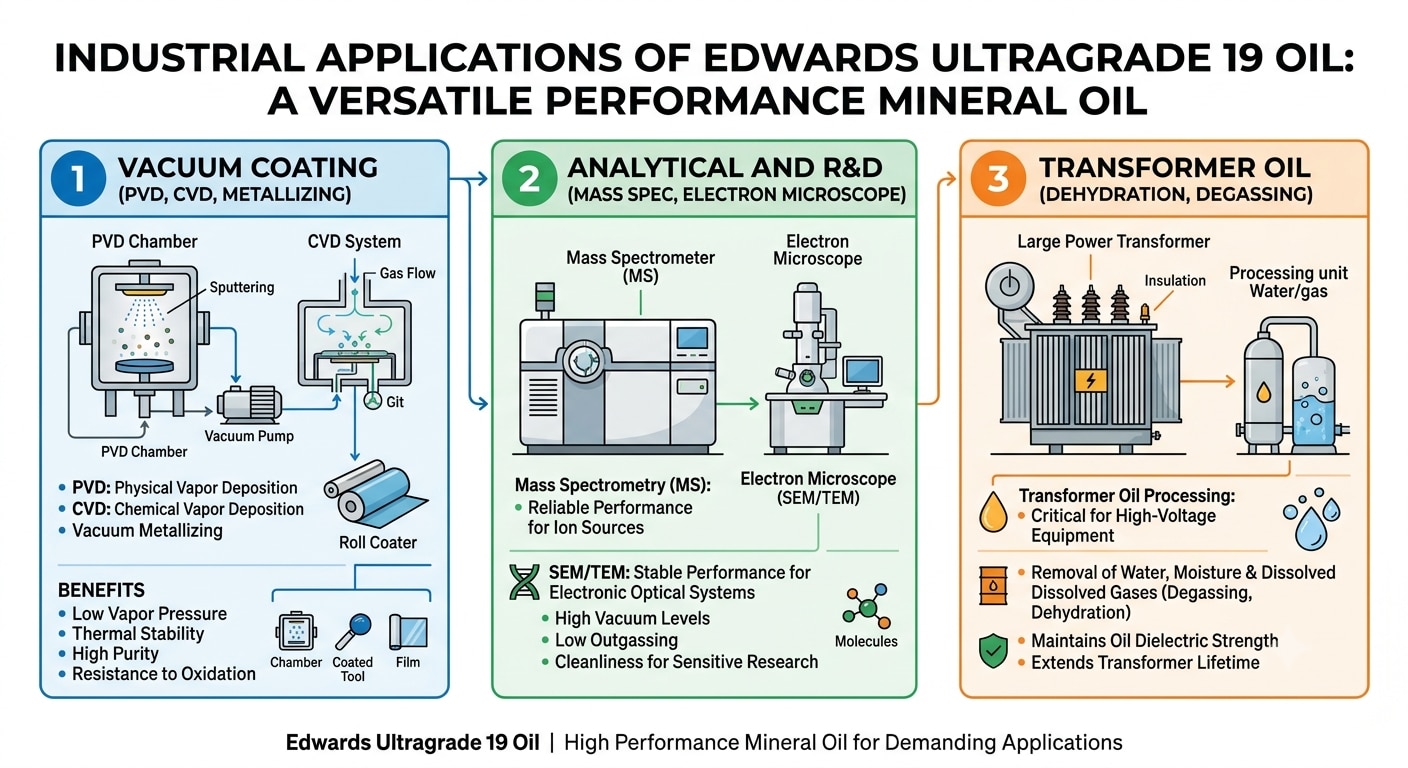
Industrial Applications Across India
Edwards Ultragrade 19 is used across several manufacturing and analytical sectors in India:
Maintenance & Oil Replacement Best Practices
To maximize pump life and fluid performance in Indian climate conditions, follow a structured maintenance routine:
Monitor Fluid Color & Clarity:
Clear / Pale Yellow: Good condition.
Dark Brown / Black: Thermally oxidized; drain and replace immediately.
Milky / Opaque: Water condensation contamination; run gas ballast or change oil.
Flush During Fluid Changes: When changing heavily degraded oil, flush the casing with a minor charge of clean vacuum oil, run for 5 minutes, drain, and refill to the sight-glass center mark.
Control Operating Temperatures: Ensure ambient room temperatures stay below $40^\circ\text{C}$ or implement forced-air cooling on continuously running rotary vane pumps.
Sourcing Options: OEM vs. Equivalent Indian Fluids
When purchasing Ultragrade 19 in India, buyers generally select between two main supply paths:
Original Edwards Imported Packs: Available through authorized distributors in standard 1-Liter, 4-Liter, and 20-Liter containers.
Indian Chemical Equivalent Formulations (e.g., DHVE 19 / DVO Grade Oils): Domestic manufacturers produce direct hydrocarbon equivalents formulated to match the ISO VG 46 viscosity index, hydrotreated mineral base, and vapor pressure specs of Ultragrade 19. Matching specifications through local manufacturers can lower procurement costs and shorten supply chain lead times.
Frequently Asked Questions (FAQ)
Can I mix Ultragrade 19 with general hydraulic or motor oil?
No. Motor oils contain detergent additives, anti-wear agents, and lighter fractions that vaporize under low pressure, causing vacuum loss, severe pump smoking, and internal varnish build-up. Always use hydrotreated vacuum oil.
What is the difference between Ultragrade 19 and Ultragrade 20?
Ultragrade 19 (ISO VG 46 class) is designed for small-to-medium rotary vane pumps operating under standard ambient temperatures. Ultragrade 20 (ISO VG 68 class) has a higher viscosity, designed for larger industrial pumps or systems operating continuously at higher thermal loads.
How often should vacuum pump oil be changed?
Under clean, dry running conditions, change the oil every 2,000 to 3,000 operational hours. For applications involving solvent vapors, moisture, or particulate drag-over, inspect weekly and change every 500 to 1,000 hours.